Sunday, February 8, 2015

The LISP Connection

"There is a history in all men's lives"
-- Shakespeare, Henry IV Part 2
Act III, Scene I, Line 76


Questions not asked


Why are there so many conference sessions about things to come and how things will get better?

Why are there so many blog posts about what is new and the 5 to 10 things you should know about them?

How many sessions are there that reflect upon the past and what we've learned along the way?

How many blog posts are there about the history of programming and the important lessons we've learned along the way?

What I like about Lisp


LISt Processing is one of the oldest computer languages (FORTRAN is older by a year).  Using LISP or one of its dialects you feel a connection to those programmers and scientist that came before you.

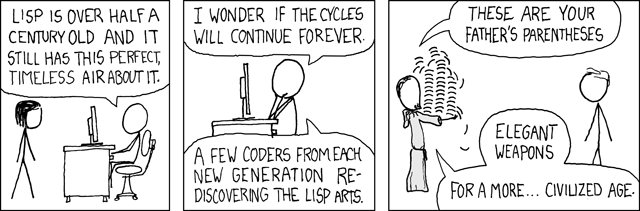
Randall Munroe's xkcd, Lisp Cycles

This sense of connection is an old but very important idea.

What Lisp has taught me thus far


Over the past few months I've been learning Clojure from the Joy of Clojure and now Programming Clojure, here are the things I've learned thus far:


  • homoiconic leads to fewer syntax errors and easier to read code
  • compose functionality from smaller well tested functionality
  • separate assignment of values from actions upon values
I look forward to continuing my path along the Lisp way.

Unlikely credits


Questions not asked and titled inspired by the Rainbow Connection, written by Paul Williams.


Sunday, February 1, 2015

Reducing Filter to Reduce OR All You Need is Fold

"All springs reduce their currents to mine eyes"
-- Shakespeare, Richard III
Act II, Scene II, Line 68

Intro


Last time we look at using the ideas presented in Graham Hutton's paper "A tutorial on the universality and expressiveness of fold" around mapping map to a fold.  This post will look at filtering filter down to a fold.

Filter


Filter goes by many different names, to those who speak Clojure, Haskell, and Underscore.js it is called Filter, to others that speak C# it is know as Where, while those that speak C++ know it as Remove, ... we could go on like this for a bit.


The point is that this is the same idea called by different names.  With a Filter what you are doing is taking a collection and applying a predict which state which members of the collection to let into the resulting collection and which members to not allow.  Think of it as a bouncer at a club, some of the people looking to get in will be admitted to the club others will be turned away, the bouncer is the predict, the people are the collection, and those few that get into the club are the resulting collection.

An easy example is to filter out all members of a collection of integers which are not odd.  In Clojure and C# we could use the following code to do this.


We see in both languages that we can use a higher order function to filter our collection down to the resulting collection with the property of oddness that we are looking for.  Clojure has a built in predicate function to check for oddness of a number while in C# we have to roll our own with a lambda function.

Fold


We talk about Fold last time, but we'll review it really quick.


When we are talking about Fold we are talking about taking a collection and applying a function against each member of the collection resulting in a result of a single "value".

Hmm, this sounds kind of similar to what we are doing with Filter...

Folding Filter into a Fold


When we looked at Filter we saw some similarities to Fold.

  1. apply a function to each member of a collection
  2. building a result

In fact we could look at Filter in the following way:


If we take a Fold (aka Reduce), a predicate function, and a collection to hold the resulting collection, we end up with a Filter.  We can looking at the following examples in Clojure and C# using our friend isOdd with a Fold to produce a Filter


In the Clojure code we see that we have a predicate function testing if a value is odd and if it is we conj it to a memorized resulting collection else we just pass along the memorized result collection.  We seed the Reduce (aka Fold) with an empty vector was is used to hold the memorized result collection.  Note, the memorized result collection is %1 in the lambda function while the current member we are looking at is %2, this pattern is typical in Folds across different languages (I cannot think of one which does not have this as the order, but maybe one exist).

In the C# code we new up a List to hold our resulting collection and in our lambda we test the current member we are looking at, if it passes we add it to the memorized result collection, then we always pass the memorized result collection along to the next call of Aggregate (aka Fold).  Since we had an array of integers as our input, we need to reshape the result collection with a call to ToArray.

By looking at this simple example we see that all we really need is Fold.  :)

Sunday, January 25, 2015

Reducing Map to Reduce OR All You Need is Fold

"That would reduce these bloody days again"
-- Shakespeare, Richard III
Act V, Scene V, Line 36

Intro


Have you heard the tale of the madman who came running into the town late at night, screaming that all you need is fold?

In Graham Hutton's paper "A tutorial on the universality and expressiveness of fold" it is shown that we can reduce recursive functions into a definition using fold.  Let's take a look reducing map to a fold.

(O-the tale of the madman is about me and not Dr. Hutton.)

Map


Map goes by a few different names, to those who speak Clojure, Haskell, or Underscore.js it goes by the name Map, to those which speak C# it goes by the name Select, those who speak C++ call it Transform, ... we could go on like this for a bit.


The point is that idea of the higher order function Map goes by different names in different language but performs the same function of taking a collection and applying a function against each member and placing it into the resulting collection.


The easiest example that actual does something is to apply an increment function with a Map.  Looking above we see that when we Map the increment function against a collection with the members of 1, 2, 3, 4 we get a resulting collection with the members of 2, 3, 4, 5.

In Clojure and C# it would look like this:


Fold


Fold goes by a few different names too, to those that speak Clojure or Underscore.js it goes by the name Reduce, to those which speak C# it is known as Aggregate, in Haskell it is known as Fold, in C++ it goes by the name Accumulate, ... we could go on like this for a while.  Again the point is that these names are all for the same idea of the higher order function Fold.


A Fold takes a collection and applies one function against each member of the collection and an accumulated result (also known as a memorize).

A very simple example of Fold would be summing.


We see in the image above that we are taking the collection 1, 2, 3, 4 and summing it up to the value of 10.  We do this by taking member 1 and the seed value of 0 and adding them together to get 1.  Next, we take the accumulated value of 1 and add the next member 2 to it giving us 3.  Then, we take the accumulated value of 3 and the member 3 add them and get 6.  Last, we take the accumulated value of 6 and the member of 4 giving us the final result of 10.

In Clojure and C# this would look like the following:


Mapping Map to Fold


... and birds go tweet, what is the point?  Glad you asked, we see with both Map and Fold some similarities.

  1. applying a function against each member of a collection
  2. building a resulting collection
Let's look at the first Map example again.  We see that we applying a function against each member of a collection and are accumulating a resulting collection, this sounds very similar to Fold.


In fact I would say that if we had an empty collection in which we accumulated the results of applying the function against the members of the collection we would have the same functionality.  That was a lot of words lets have some code.

In Clojure and C# we would have the following:


We see that both Map and the Fold give the exact same result.  In both the Clojure and C# code we see that we need an initial empty collection to store the resulting collection in and place the result of applying the function against a member into the resulting collection (using conj in Clojure and Add in C#).  For the C# code since we are using a List to accumulated the resulting collection instead of an array we need to reshape the resulting collection using the ToArray method.

By looking at this simple example we see that we can reduce Map to a Fold and thus all we need is Fold.  :)

Sunday, January 11, 2015

The city of Mapcat

"I have forgot the map."
-- Shakespeare, Henry IV Part I
Act III, Scene I, Line 5.1

Mapcat is an interesting higher order function which is not talked about much.

"You've never danced like this before
We don't talk about it"
-- Milky Chance,
Stolen Dance

The simplest case of Mapcat is when you have a collection of collection and you want to map over the collection of collection yielding a single level of collection.


In the image above we see that we have a collection of two collections (top and bottom) and a function which maps and cats (mapper catter) when these are Mapcatted that yield a result which is a single collection.  The size of the result from the Mapcat is the size of the collection's collections, in the image above we see that we have 4 members of the first collection and 2 members in the second collection giving us the resulting collection with 6 members.

The simplest example of Mapcat would be using the identity function (a function which just returns whatever is given to it).


We see that collection which contains a collection we 1, 2, 3, and 4 and another collection with 20 and 10 when Mapcatted with the Identity function will yield a resulting collection with 1, 2, 3, 4, 20, and 10.


We see in C# we can use the SelectMany to perform this simple Mapcat, while Clojure has a function called mapcat.

This is nice but how about a simple example which actual does something?


How about incrementing the values?


We see that in both C# and Clojure the lambda in the Mapcat is given a collection, so in both cases we need to have a function which can work with a collection.  We have a choice in both C# and Clojure we can either have a Map in the lambda or we can chain the result by removing a level with the identity function follow by a simple Map with an incrementing lambda function.  In Clojure we can do chaining using the double arrow macro (thread last) ->> or just nest the calls.

Saturday, January 3, 2015

On Zipping

"With those legions
Which I have spoke of, whereunto your levy
Must be supplyant: the words of your commission
Will tie you to the numbers and the time
Of their despatch.
"
-- Shakespeare, Cymbeline
Act III, Scene VIII, Lines 12.2 - 16.1

Zipping is a very simple concept from higher order functions which does not get talked about much.

With a zip you have a number of collection which you wish to apply a function against each matching member in order to produce a single "zipped" collection.

In general:

GIVEN a function f

FOREACH x_i in X, y_i in Y, ...
  r_i = f(x_i, y_i, ..)

GIVING r_i in R

The function f is the "zipper", while X, Y, ... are the collections being zipped with R being the zipped result.

A simple example with 2 collections:


Let's use Add as the "zipper", [1, 2, 3] as the first collection, and [10, 20, 30] as the second collection.


We see that this gives us the resulting collection of [11, 22, 33].

What should happen if the first or second collection has a different number of elements?


OR


We'll look at what C#, Clojure, and Haskell do in these cases.


We see that they each have a resulting collection as large as the smallest input collection and simply just ignore the rest of the input in the larger collection.  There you have it a very simple introduction to Zip.